


Current transformers (CTs) play a critical role in power measurement, protection, energy monitoring, EV charging, and industrial automation systems. While winding design and mechanical structure are important, one of the most influential factors affecting CT performance is often hidden inside the magnetic core—the hysteresis characteristics of the magnetic material.
At ZTC, with more than 30 years of current transformer manufacturing experience, we have learned that selecting the right magnetic material is only the first step. Understanding and applying hysteresis characteristics throughout design, manufacturing, and quality control is essential for producing reliable, high-accuracy current transformers.
ZTC explains how hysteresis characteristics affect CT performance and shares engineering considerations from real manufacturing practice.
What Is Magnetic Hysteresis?
Magnetic hysteresis describes how a magnetic material responds when subjected to an alternating magnetic field. The relationship between magnetic field strength (H) and magnetic flux density (B) forms the well-known B-H hysteresis loop.
For current transformers, hysteresis characteristics directly influence:
• Measurement accuracy
• Linearity
• Core saturation behavior
• Hysteresis loss
• Residual magnetism
• Long-term stability
A magnetic core with high permeability and low hysteresis loss enables the CT to detect current changes more accurately while maintaining consistent performance over time.
Engineering Practice 1: Selecting the Right Magnetic Core Material
Choosing the proper magnetic material is one of the earliest and most important design decisions.
In practical engineering, material selection depends on multiple factors, including:
• Operating frequency
• Current range
• Accuracy requirements
• Temperature rise
• Cost-performance balance
• Long-term stability
For applications requiring high sensitivity, such as residual current detection, leakage protection, and precision energy measurement, magnetic materials with high permeability and low hysteresis loss are generally preferred.
Rather than relying solely on material datasheets, engineers evaluate the magnetic behavior of core materials under actual operating conditions.
Figure 1. B-H Characteristics of Permalloy Core Material at 50 Hz

Main hysteresis loop at 50Hz
The B-H characteristic curve of permalloy material measured at 50 Hz demonstrates high permeability and a relatively narrow hysteresis loop. These characteristics contribute to improved sensitivity, reduced hysteresis loss, and higher measurement accuracy for current transformer applications.
Before selecting a magnetic core, engineers should evaluate whether the material can provide sufficient magnetic permeability while remaining within its linear operating region during normal operating conditions.
Engineering Practice 2: Understanding Frequency Effects
Modern electrical systems rarely operate under a perfect 50/60 Hz sinusoidal waveform. Variable frequency drives, EV chargers, renewable energy systems, and switching power supplies introduce harmonic currents that change the magnetic behavior of the core.
Evaluating magnetic characteristics at multiple frequencies helps engineers predict CT performance in real-world applications.
Figure 2. B-H Characteristics of Permalloy Core Material at 150 Hz

Main hysteresis loop at 150Hz
The magnetic characteristics measured at 150 Hz (the third harmonic of a 50 Hz system) illustrate how frequency influences magnetic performance. Understanding these changes helps engineers optimize current transformers for applications containing harmonic components.
Engineering Note: The magnetic characteristic curves shown above were measured by a national laboratory specializing in electromagnetic measurements and are referenced here to illustrate engineering principles used during current transformer design.
Engineering Practice 3: Reducing Hysteresis Loss
Hysteresis loss represents energy dissipated during each magnetization cycle.
Although often overlooked, excessive hysteresis loss may lead to:
• Reduced efficiency
• Higher temperature rise
• Lower measurement stability
• Increased long-term drift
At ZTC, reducing hysteresis loss involves more than selecting a suitable magnetic material.
Engineering optimization may include:
• Selecting appropriate core materials
• Optimizing core dimensions
• Designing suitable winding parameters
• Controlling winding consistency
• Performing magnetic core inspection
• Maintaining stable manufacturing processes
These combined improvements help maintain stable performance throughout the product lifecycle.
Figure 3. Hysteresis Loop of Permalloy Core Material
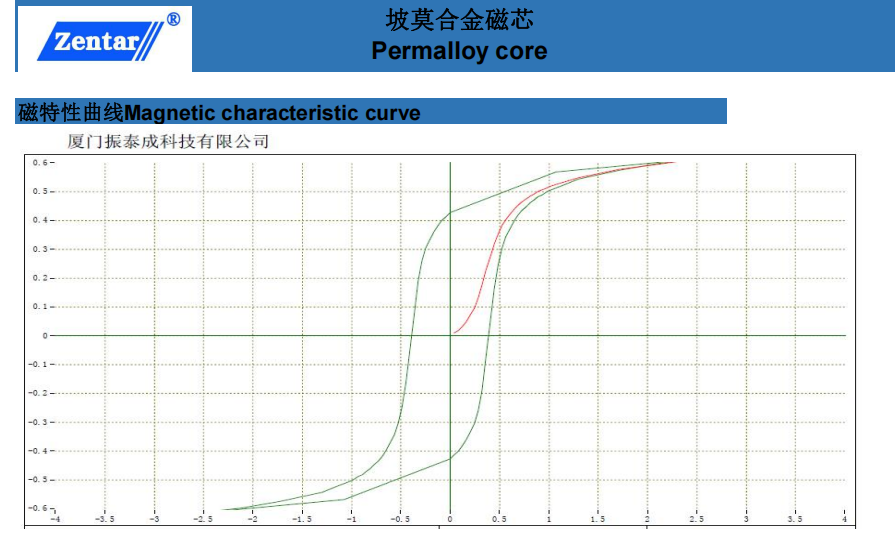
Hysteresis Loop of Permalloy Core Material
A narrow hysteresis loop generally indicates lower hysteresis loss and lower residual magnetism, helping improve current transformer efficiency, output stability, and long-term measurement consistency.
Engineering Practice 4: Minimizing Residual Magnetism
Residual magnetism (remanence) is particularly important for zero-phase current transformers and residual current detection applications.
Excessive remanence may result in:
• Initial measurement errors
• Reduced sensitivity
• Unstable low-current output
• Inconsistent product performance
During product development and manufacturing, engineers should evaluate not only magnetic material properties but also production processes that influence magnetic performance.
Manufacturing Experience Matters
Many engineers assume that using the same magnetic core material guarantees identical CT performance.
In reality, manufacturing consistency plays an equally important role.
Factors such as:
• Winding tension
• Assembly precision
• Core handling
• Testing procedures
• Process control
all contribute to the final accuracy and consistency of a current transformer.
This is why two CTs using similar magnetic materials may still exhibit different performance in mass production.
Common Engineering Mistakes
Based on our manufacturing experience, several common mistakes can affect CT performance:
• Selecting magnetic materials based only on permeability values.
• Ignoring hysteresis characteristics under harmonic frequencies.
• Allowing the core to operate close to saturation.
• Overlooking residual magnetism during design validation.
• Focusing on material selection while neglecting manufacturing consistency.
Considering these factors early in product development can significantly improve product reliability.
Magnetic hysteresis characteristics are far more than theoretical concepts found in textbooks. They directly influence the accuracy, efficiency, stability, and long-term reliability of current transformers.
Successful CT design requires a combination of appropriate magnetic material selection, engineering analysis, manufacturing expertise, and strict quality control.
By understanding how magnetic hysteresis behaves under real operating conditions and integrating this knowledge into manufacturing practices, engineers can build current transformers that perform consistently across demanding industrial applications.
About ZTC
For more than 30 years, ZTC has specialized in designing and manufacturing current transformers for electrical safety, energy monitoring, industrial automation, smart metering, and EV charging applications.
Our engineering team supports customers with:
• Current transformer design optimization
• Magnetic core selection
• OEM & ODM development
• Manufacturing transfer projects
• Mass production support
• Customized engineering solutions
Whether you are developing a new product or optimizing an existing design, ZTC is committed to delivering reliable current transformer solutions backed by proven engineering experience.
Need Engineering Support?
If you are looking for an experienced current transformer manufacturer or need assistance selecting magnetic core materials for your application, our engineering team is ready to help.
Contact ZTC today to discuss your next current transformer project.